
What you should know before taking Albuterol Inhalation Solution?
Review the important warnings, precautions, possible side effects and treatment information before using this product.
Generic For AccuNebAsthma Treatment
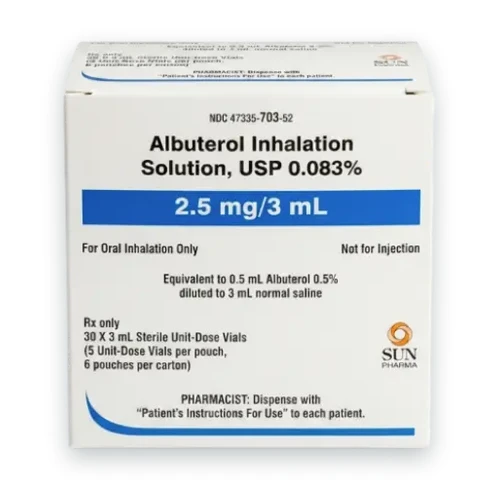


Selected option:0.083% (2.5 mg), 1 90ML (30x3ML Vials)
See important safety information (opens in a new tab)
Images are for illustration purposes only. Actual product, packaging and pack size may differ.
Next: a short medical questionnaire. A licensed provider reviews your answers and decides whether treatment is appropriate for you.
Albuterol inhalation solution relieves bronchospasm - the sudden tightening of the muscles around your airways that makes breathing hard. It’s approved for people 2 years and older with reversible obstructive airway disease, and for acute attacks of bronchospasm. Most people using it have asthma, though it’s also used in other conditions where airways narrow. It belongs to a group of medicines called short-acting beta2-agonists. In plain terms, it relaxes the muscle wrapped around your airways so they open up and air moves more easily. You breathe it in as a mist through a nebulizer machine rather than swallowing it, which puts the medication straight into your lungs. Outside the US you may see it called salbutamol - same drug. One thing worth being clear about: this is a rescue medication, not a controller. It opens airways fast but does nothing about the underlying inflammation that causes asthma in the first place. It isn’t meant to replace a daily preventer inhaler if you’ve been prescribed one.
Twist the cap off one vial and squeeze the whole thing into the nebulizer cup. Then connect the cup to your mouthpiece or face mask, attach it to the compressor, and sit upright in a comfortable position. Turn the machine on and breathe as calmly, deeply and evenly as you can until no more mist comes out of the chamber. That usually takes 5 to 15 minutes. When the mist stops, the treatment is done. Clean the nebulizer parts afterward following the manufacturer’s instructions, since a dirty nebulizer can grow bacteria. A few practical points. Use the entire vial - it’s a single dose, not something to split or save. Don’t put other medications in the same cup unless your provider specifically told you to, because mixing hasn’t been tested for safety or effectiveness. Sitting upright matters more than people expect; slouching makes it harder to get the mist deep into your lungs.
Shakiness is by far the most common. In clinical trials, tremor was reported by about 20% of patients - the jittery, unsteady-hands feeling many people notice within minutes of a treatment. After that: dizziness (7%), nausea (4%), nervousness (4%), cough (4%), headache (3%), and insomnia, faster heartbeat, raised blood pressure, and stuffy nose at around 1% each. Most of these come from the medication reaching the rest of your body, not just your lungs, and they fade as it wears off. Albuterol can also lower potassium temporarily. In children aged 5 to 17 given repeated higher doses, potassium fell 20% to 25% without causing symptoms, and the drop usually corrects itself. Two things need immediate attention. If your breathing gets worse right after a treatment rather than better, that’s paradoxical bronchospasm - stop and get medical help, because it can be life-threatening. Rash, hives, swelling of the face or throat also mean stop and call for help.
*Prescription products require an online consultation with a licensed healthcare provider who will determine if treatment is appropriate. Individual results may vary.
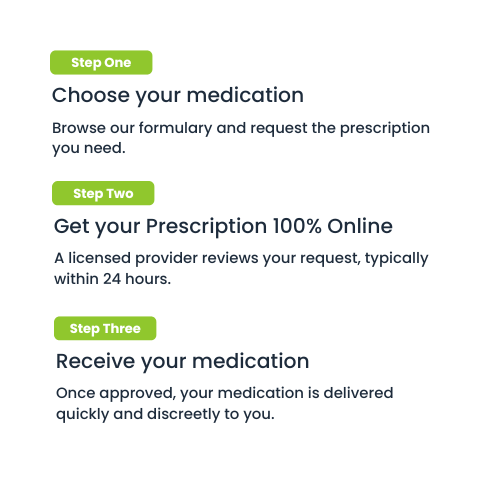
A few simple steps to your medication
US Quick Health
If not eligible: 100% money-back guarantee.
Review the important warnings, precautions, possible side effects and treatment information before using this product.
Most people start breathing easier within about 5 minutes. In clinical trials, lung function measurements showed improvement that fast in most patients. The effect keeps building and usually peaks around an hour after the treatment, staying close to that peak for roughly 2 hours. From there it tapers off. Meaningful improvement lasted 3 to 4 hours for most people, and up to 6 hours for some. In children aged 3 and older, studies found improvement within 2 to 20 minutes of a single dose. So the practical picture is: relief starts quickly, peaks around the one-hour mark, and generally covers you for 4 to 6 hours. That timing is why the usual schedule is three or four treatments a day rather than more. If you find the effect wearing off much sooner than it used to, that’s worth reporting rather than working around. A shrinking window of relief usually means the asthma itself is getting worse, not that the medication has stopped working.
The usual dose is one 2.5 mg vial three to four times a day for adults and for children weighing at least 15 kg (about 33 pounds). The label is explicit that more frequent treatments or higher doses aren’t recommended. Because the effect can last up to six hours, using it more often than prescribed stacks doses on top of each other and raises your risk of a racing heart, tremor, and low potassium. Don’t increase the dose or the frequency on your own - that’s a conversation to have with your provider first. This matters more than it might sound. Deaths have been reported in connection with excessive use of inhaled rescue medications, including at-home nebulizer use, which is exactly why the dosing ceiling exists. Needing your nebulizer more often than usual isn’t something to push through. Current asthma guidelines treat frequent reliever use as a warning sign of poorly controlled asthma and a predictor of serious flare-ups.
Neither one is clearly better for most people. This surprises a lot of patients who assume the machine must deliver more medication. When researchers have compared an inhaler used with a spacer against a nebulizer, pooled results across many trials found no meaningful difference in how well people breathed afterward or how likely they were to need hospital care. One consistent difference did show up: nebulizer treatments tended to raise heart rate more. What actually separates them is practicality. A nebulizer takes 5 to 15 minutes, needs power and cleaning, and stays at home - but it requires no coordination, which helps if you’re very short of breath, elderly, or treating a small child. An inhaler with a spacer works in seconds, fits in a pocket, and costs less per dose, but only if your technique is right. Plenty of people use both: the nebulizer at home, an inhaler when out. Your provider can advise which fits your situation.
No. The 0.083% strength is already diluted and ready to use straight from the vial. Each 3 mL vial contains 2.5 mg of albuterol in a sterile saline base, so you just empty it into the nebulizer cup as-is. This is the main thing that separates it from the 0.5% concentrate, which is a much stronger solution that must be diluted with sterile normal saline before it can be nebulized. Mixing up the two is a genuine dosing error, so it’s worth checking which one your prescription is for. There’s one situation where the 0.5% is actually preferred: children under 15 kg who need less than a full 2.5 mg dose, since a smaller volume can be measured out. Storage matters too. Keep the vials in their foil pouch until you use them, protected from light, at 2° to 25°C (36° to 77°F). The solution should be clear and colorless to light yellow. Throw away any vial that looks discolored.
Yes, from age 2 onward. Safety and effectiveness have been established in children 2 years and older, but not in children under 2. For kids weighing at least 15 kg (roughly 33 pounds), the dose is the same as for adults: one 2.5 mg vial, three to four times daily. Below that weight, if a child needs less than a full vial, the 0.5% concentrate is used instead so a smaller dose can be measured accurately. Young children usually do better with a face mask than a mouthpiece, since it doesn’t rely on them sealing their lips or breathing on cue. Expect the same side effects adults get, sometimes more visibly - jitteriness, hyperactivity, and a faster heartbeat are common in the half hour after a treatment and settle on their own. Sticking to the prescribed frequency is especially important in children. In cases of accidental overdose in kids aged 2 to 12, heart rates above 200 beats per minute have been recorded.
Albuterol isn’t addictive. It’s not a controlled substance, there’s no craving or high, and you won’t get withdrawal symptoms if you stop. Repeated-dose studies showed it kept working across three months of treatment. But there’s a real concern buried inside this question that deserves a straight answer. If a dose that used to help stops giving you the usual relief, the label says to seek medical advice immediately, because that’s often a sign the asthma itself is getting seriously worse - not that you’ve built tolerance. Separately, major asthma guidelines updated in 2025 no longer recommend treating asthma with a rescue medication alone. Relying on albuterol without an anti-inflammatory controller is linked to more severe flare-ups, more emergency visits, and higher risk of death. So the pattern people describe as “getting dependent on my nebulizer” is usually untreated inflammation showing itself. The fix is reviewing your whole treatment plan, not using the nebulizer less.
Get medical help right away rather than taking another treatment. When a dose that normally works fails to give the usual relief, that’s a recognized sign of seriously worsening asthma that needs reassessment, and the label says to seek advice immediately. Repeating treatments to force it to work is the dangerous move here - higher or more frequent doses aren’t recommended, and excessive use of inhaled rescue medication has been linked to deaths. Call 911 or get to an emergency room if you can’t speak in full sentences, your lips or fingernails look blue or grey, you’re working hard to breathe, or symptoms keep worsening despite treatment. Also stop and seek help if your breathing gets worse immediately after a treatment instead of better. If you don’t already have a written asthma action plan spelling out what counts as a yellow-zone day versus a call-911 day, ask for one. Knowing the thresholds in advance is far easier than deciding while you’re struggling to breathe.
This decision is made by the licensed physician. There are no adequate, well-controlled studies in pregnant women. Albuterol is classified Pregnancy Category C, meaning it should be used during pregnancy only when the likely benefit justifies the possible risk. Animal studies did show birth defects at doses above the human range, and rare congenital anomalies have been reported over decades of use, though no consistent pattern emerged and no causal link has been established. The other side matters just as much. Poorly controlled asthma in pregnancy carries its own well-documented risks to both mother and baby, which is why most providers treat asthma during pregnancy rather than stopping medication. Two extra notes: albuterol can affect uterine contractions, so it’s used cautiously near labor, and it’s unknown whether it passes into breast milk. Tell your provider you’re pregnant, trying, or breastfeeding during the consultation.
Medication prices are clearly displayed on each product page, so you’ll always know exactly what you’re paying. Choose a subscription to save compared with a one-time purchase - and enjoy transparent pricing, no hidden fees, and free shipping.
AccuNeb® (Albuterol Sulfate) Inhalation Solution - Prescribing Information. / Source: U.S. Food and Drug Administration (FDA) Link: FDA / Published: 2011
Medically reviewed by
Clinical Expertise: Anesthesiology, Emergency Medicine, Urology, and Oncology
Dr. Igde reviewed the medical information on this page for accuracy against current medical knowledge. This is an editorial, non-clinical review: it is not medical advice and does not create a doctor-patient relationship. Whether a treatment is appropriate for you is decided by an independent U.S. licensed provider.
For more information about the scope of the reviewed content and the role of our medical advisors, please visit our Medical Board page.

*All information presented on this page is for informational and educational purposes only and does not constitute medical advice, diagnosis, or treatment. Prescription products are available only after an online consultation with a licensed U.S. healthcare provider who determines if treatment is appropriate. Individual results may vary. US Quick Health LLC does not sell or ship medications directly. All prescriptions are fulfilled by licensed U.S. pharmacies.